A lot of AI coding demos look impressive for about five minutes.
Then reality shows up.
Reality is the old service nobody wants to touch on a Friday afternoon. Reality is the module with naming debt, historic compromises, and a commit history that reads like a crime scene. Reality is the enterprise Java codebase that still has to pass review, survive incidents, respect architectural boundaries, and keep making money after the demo is over.
That is why JetBrains Air got my attention.
Not because the market needed one more AI product. Not because I believe every new agent interface deserves applause. And definitely not because I think serious software development is about to collapse into a single infinite chat thread. I have never bought that story.
What matters here is who is building this, how they are framing the product, and what that means for developers who work in large, structured codebases.
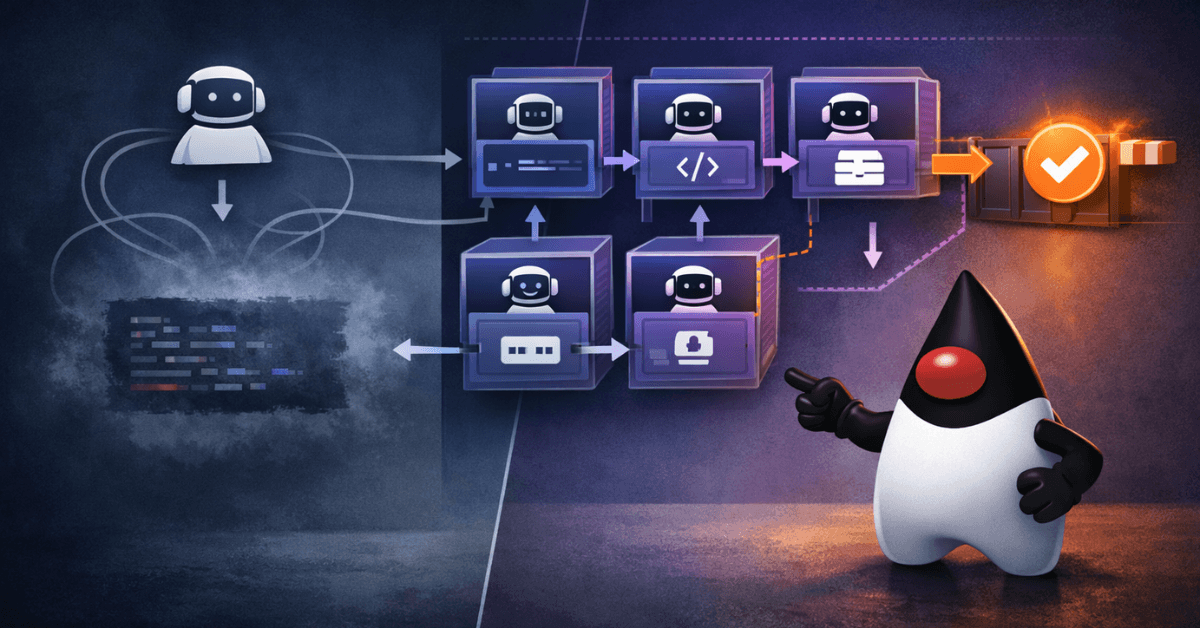
JetBrains did not announce Air as a new IDE. It also did not frame it as a glorified coding chatbot. The company calls it an agentic development environment, and that distinction matters. Air is built on the codebase of Fleet, JetBrains’ lightweight IDE that was discontinued in December 2025 without ever reaching general availability, and its foundation has been repurposed for this agent-centric architecture. Air is designed to let developers delegate coding tasks to multiple AI agents and run them concurrently, with precise references to the codebase. You can point an agent to a specific line, commit, class, method, or symbol instead of pasting a giant chunk of text and hoping for the best.
That sounds simple, but in practice it changes the quality of the interaction in a very meaningful way.
If you build Java systems for a living, you already know the hard part is not generating a class. The hard part is understanding where that class belongs, which contracts it must respect, what side effects a change might trigger, and how a single local decision ripples through a broader architecture. That is where shallow tooling starts to fail. Context is not a bonus in enterprise development. Context is the job.
And that is the main reason this launch matters.
Why Air deserves attention from Java developers
JetBrains says Air is built on 26 years of experience creating developer tools. That is not empty positioning. This is the company behind IntelliJ IDEA, a tool that many Java developers trust more than any other part of their daily workflow. It is where refactorings are expected to be reliable. It is where navigation actually helps. It is where framework integrations usually understand what they are doing. It is where inspections catch expensive mistakes before they become production incidents.
When a company with that history starts building around agents, I pay attention.
A lot of conversations about AI tooling still pretend that tools are neutral. They are not. Every tool reflects the worldview of the people who built it. JetBrains has deep experience with statically typed languages, symbol resolution, code navigation, inspections, refactoring, and long lived codebases. That background makes Java a very natural fit for the type of environment Air is trying to become.
No, I am not saying Air is only for Java. That would be silly. The Public Preview announcement explicitly says Air supports Codex, Claude Agent, Gemini CLI, and Junie out of the box. JetBrains also says Air supports the Agent Client Protocol and will add support for other ACP agents through the ACP Agent Registry. On top of that, the product can run agents locally by default and isolate work in Docker containers or Git worktrees for sandboxing and concurrent execution.
That matters for everyone.
But I do think Java developers are particularly well positioned to benefit from this model, and the reason is structural. Java development rewards clarity, explicit contracts, rich metadata, stable workflows, and tools that understand code semantically instead of treating it as plain text. In small toy projects, almost any AI assistant can look decent. In real repositories with multiple modules, framework conventions, architectural constraints, and long maintenance horizons, the conversation changes fast.
That is where orchestration plus context becomes more valuable than raw generation.
Air is not trying to replace the IDE, and that is a good sign
One of the strongest parts of the announcement is what JetBrains does not claim.
JetBrains says complex codebases are not yet ready for pure agentic coding. Good. That is the kind of sentence I trust more than a polished demo. It signals a level of realism that is still too rare in this market.
The company also says Air handles agent powered development while your IDE handles the rest. That is a much healthier model than the idea that all serious engineering work will move into a single chat interface. I do not think that is how durable software gets built. Not in teams. Not in regulated environments. Not in systems that have to survive handoffs, audits, maintenance cycles, and post incident learning.
The stronger operating model is something like this: delegate bounded tasks to agents, let them work with clear context, isolate work when necessary, then review and integrate the results using tools that already understand the shape of the codebase.
For Java teams, that story is especially credible because IntelliJ IDEA has already earned that trust over many years.
This is why I think dismissing Air as just another shiny AI release is a mistake. The real signal is not the interface alone. The signal is that JetBrains is pushing toward a workflow where agents become orchestrated contributors inside a broader development environment instead of becoming the entire environment.
That is a more serious thesis.
What the official announcement actually says
It is worth grounding this in the details JetBrains published.
According to the Public Preview post, Air is available to developers with a JetBrains AI subscription or to people who already have subscriptions to supported agent providers and API keys. JetBrains specifically notes an exception around Anthropic in that sentence, which is important because many developers care a lot about model choice and provider flexibility.
Later in the same post, JetBrains says developers can bring API keys from Anthropic, OpenAI, or Google, and that BYOK usage will be used first before falling back to the JetBrains subscription for anything not covered. That combination suggests the overall model access story is still evolving in practice, even if the direction is clearly broader interoperability.
I would not treat that as a fatal problem. Public Preview is exactly the phase where these operational edges become visible. But I would treat it as something worth watching closely if your team has strong expectations around provider choice, subscription boundaries, procurement rules, or how usage gets billed.
This is one of those details that many announcements gloss over. JetBrains did not gloss over it completely, and that is useful.
The launch post also says cloud execution for remote agent runs in isolated sandboxes is in tech preview and coming soon for Air users. That is another meaningful signal. Local agent execution is already useful, but remote isolated execution is where multi task workflows can become much more practical for teams that want separation, safety, or cleaner experiments.
Again, the key here is not hype. The key is trajectory.
Why this aligns so well with real world Java work
Java development has always had a stronger relationship with structure than many other ecosystems.
That is not because Java developers are more noble, smarter, or somehow spiritually aligned with architecture diagrams. It is because the ecosystem naturally pushes teams toward explicit boundaries, framework conventions, type driven navigation, and workflow discipline. If you have spent enough time in production Java systems, you know the cost of getting context wrong.
A generated snippet is rarely the bottleneck.
The bottleneck is understanding whether the snippet belongs in that module, whether the contract is right, whether a refactor changes runtime behavior, whether a framework integration breaks, whether naming communicates intent, whether a service boundary stays clean, and whether you are introducing a mess that somebody else will have to clean up in six months.
That is why I think Air is more interesting than many tools that focus only on a prompt box.
Air is built around the idea that the task definition itself matters. Mentioning a specific method, class, symbol, line, or commit is not a cosmetic detail. It gives the agent more precise grounding. Better grounding usually means better output, faster review, and fewer rounds of vague clarification.
If that sounds obvious, good. A lot of tooling in this space still behaves as if obvious things do not matter.
They do.
For Java teams, especially those working in enterprise settings, better task scoping can translate into very practical advantages:
- cleaner delegation for maintenance work
- less confusion in large repositories
- safer parallel exploration of implementation options
- better handoff between agent output and human review
- more confidence when multiple tasks are running at once
None of this removes the need for engineering judgment. It just gives that judgment a better operating surface.
The ACP angle matters more than it may seem
Another part of the story that deserves attention is ACP, the Agent Client Protocol.
JetBrains has already written about ACP and the ACP Agent Registry as a path toward more open interoperability for coding agents. The registry post describes ACP as an open standard that lets any compatible coding agent work in any supporting editor. The protocol was co-developed by JetBrains and Zed Industries, and the ACP Agent Registry was launched jointly by both companies. The analogy JetBrains uses is the Language Server Protocol, but for agents.
That matters because the AI tooling market is still full of product silos.
Developers are constantly being pushed toward closed workflows where the model, the interface, the billing, and the integration path all come from the same vendor. That is convenient until it stops being convenient. It is fine until your team wants different models, different workflows, different economics, or different safety boundaries.
A protocol based approach does not solve every problem, but it changes the power balance in a useful direction. It creates room for developer choice. It also gives products like Air a chance to become orchestration layers rather than fixed one vendor experiences.
That is strategically important.
If the future of coding agents really becomes multi agent, multi vendor, and workflow oriented, then open interoperability matters much more than a flashy single model demo. Java developers should care about this because long term enterprise tooling decisions are rarely won by the loudest launch. They are won by platforms that integrate well, evolve sanely, and reduce switching costs.
JetBrains seems to understand that.
Public Preview means promise, not certainty
This part is important because too many people evaluate preview software in extremes.
Some developers dismiss anything in preview as irrelevant. Others treat preview announcements as proof that the future has already arrived. Both reactions are lazy.
Public Preview is where you look for direction, constraints, worldview, and product instincts.
With Air, the direction seems clear: agent orchestration, concurrent task execution, stronger code context, better isolation, and a workflow that sits next to the IDE instead of pretending to erase it.
The constraints are also clear: the Public Preview is currently macOS only, with Windows and Linux versions planned for 2026 but without a confirmed date, model access details are still settling, cloud execution is not fully there yet, and the experience is still focused on individual productivity before team level collaboration. JetBrains says as much in the post.
That honesty is one reason I take the announcement seriously.
A company that says, in effect, “complex codebases are not ready for pure agentic coding,” is telling you it understands the terrain. A company that says “just trust the magic” is usually telling you the opposite.
The real mistake would be ignoring the workflow shift
The biggest mistake for Java developers right now is not waiting before adopting Air broadly. That is a reasonable decision. Public Preview software should be evaluated carefully.
The bigger mistake is dismissing the shift this launch represents.
JetBrains is telling the market that the future of development is not just one model answering one prompt at a time. It is about coordinating specialized agents, giving them precise code context, isolating tasks, and integrating the results into an actual engineering workflow.
That is a much more realistic path for serious development than the fantasy that one prompt will rewrite your architecture and call it a day.
And yes, I think that matters a lot for Java teams.
The developers who learn how to scope tasks well, direct agents clearly, and review output inside strong tooling will gain leverage. Not magical leverage. Practical leverage. Faster maintenance cycles. Better prototype exploration. More effective parallel work. Stronger review loops. Less friction when moving between experimentation and integration.
That gap will not stay theoretical forever.
It will show up in throughput, review quality, and the ability to move without turning the repository into a landfill.
My take
I do not see JetBrains Air as just another AI release trying to borrow momentum from the current market. I see it as an early but meaningful signal from one of the few companies that already understands how developers work inside large codebases.
For Java, that matters even more.
JetBrains helped shape the daily workflow of a huge part of the Java ecosystem. IntelliJ IDEA is not just a popular editor in that world. For many teams, it is the center of trusted navigation, inspection, and refactoring. So when JetBrains starts building a dedicated environment around agent orchestration, the move deserves more than casual curiosity.
You do not need to worship the product. You do not need to pretend Public Preview means proven production readiness. You do not need to become an AI maximalist.
But you do need to pay attention.
Because the platform direction is getting clearer.
Tools that understand code structure, support multi agent workflows, and preserve strong review surfaces are more likely to matter in serious Java development than tools that only make demos look smooth.
JetBrains just made that distinction a lot easier to see.
If you made it this far, thank you, really. I would love to know how you see this: are agent orchestration environments like Air the natural next step for serious Java development, or do you think the IDE should remain the only real center of gravity?
References
- JetBrains Air Blog. Air Launches as Public Preview, A New Wave of Dev Tooling Built on 26 Years of Experience. https://blog.jetbrains.com/air/2026/03/air-launches-as-public-preview-a-new-wave-of-dev-tooling-built-on-26-years-of-experience/
- JetBrains AI Blog. ACP Agent Registry Is Live: Find and Connect AI Coding Agents in Your JetBrains IDE. https://blog.jetbrains.com/ai/2026/01/acp-agent-registry/
- JetBrains AI Blog. JetBrains & Zed: Open Interoperability for AI Coding Agents in Your IDE. https://blog.jetbrains.com/ai/2025/10/jetbrains-zed-open-interoperability-for-ai-coding-agents-in-your-ide/
- JetBrains IDEA Blog. IntelliJ IDEA 2026.1. https://blog.jetbrains.com/idea/2026/03/intellij-idea-2026-1/